Categories

Machine Stretch Film vs. Hand Stretch Film: Application Differences |NAIGU

Compare machine stretch film and hand stretch film by application, wrapping speed, film consumption, load stability, and packing requirements.
Sep 10th,2026 6 Views
Stretch film is widely used to secure pallets, cartons, furniture, industrial products, and other goods during storage and transportation. However, not every application requires the same type of stretch film.
The two common options are machine stretch film and hand stretch film. Understanding their application differences can help warehouses, manufacturers, and distributors select the right film for their packing operations.
What Is Machine Stretch Film?
Machine stretch film is designed to be used with automatic or semi-automatic stretch wrapping machines. The machine controls film tension, stretching, and wrapping speed during the packing process.
This type of stretch film is commonly used in factories and warehouses with high-volume pallet wrapping requirements.
Machine stretch film can offer:
  • Consistent wrapping tension
  • Higher packing efficiency
  • Reduced manual labor
  • Stable pallet loads
  • Better control of film consumption
  • Compatibility with automated packing systems
For businesses handling a large number of pallets every day, machine stretch film can support a more standardized packing process.
What Is Hand Stretch Film?
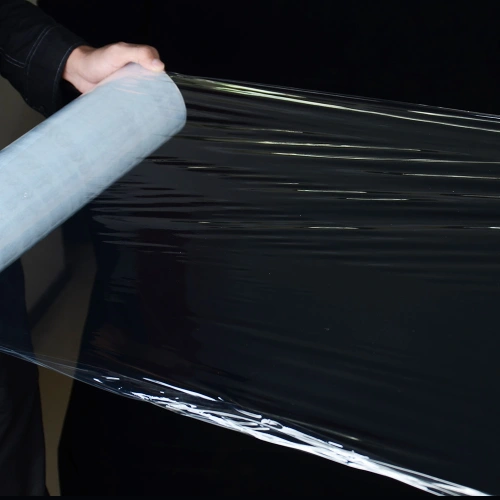
Hand stretch film is designed for manual pallet wrapping and other applications where automated equipment is not required.
Workers typically use a hand-held dispenser to wrap products or pallets. It is suitable for low-volume operations, irregular loads, and locations where flexibility is more important than automation.
Common applications include:
  • Small warehouses
  • Retail distribution
  • Small-batch manufacturing
  • Irregularly shaped loads
  • Temporary packing operations
  • Occasional pallet wrapping
Hand stretch film is generally simple to use and does not require a stretch wrapping machine.
Machine Stretch Film vs. Hand Stretch Film
Although both films are designed to secure loads, their applications are different.
Feature
Machine Stretch Film
Hand Stretch Film
Application
Machine wrapping
Manual wrapping
Packing volume
Medium to high
Low to medium
Wrapping consistency
High
Depends on operator
Labor requirement
Lower
Higher
Film tension
Machine controlled
Manually controlled
Packing speed
Faster
Slower
Equipment required
Stretch wrapping machine
Hand dispenser
Best for
Production and distribution centers
Flexible, small-scale operations
The best option depends on the company's packing volume, available equipment, labor costs, and load requirements.
1. Application Volume
Packing volume is one of the most important factors.
If a warehouse wraps only a few pallets each day, hand stretch film may be sufficient. It provides flexibility without requiring investment in wrapping equipment.
For factories or distribution centers wrapping dozens or hundreds of pallets regularly, machine stretch film can provide greater efficiency.
2. Wrapping Speed
Machine wrapping is significantly more consistent and efficient for repetitive operations.
A stretch wrapping machine can automatically rotate the pallet and apply film according to preset parameters. This reduces the amount of time required for each load.
Hand wrapping depends on the operator's speed and technique, making it more suitable for lower-volume applications.
3. Film Consumption
Machine stretch film allows manufacturers to control pre-stretch and film tension more precisely.
With the correct machine settings, businesses may be able to achieve the required load stability while using an appropriate amount of film.
Hand wrapping can produce more variation because the amount of stretch depends largely on the operator and the dispenser.
4. Load Stability
For heavy or high-value loads, consistent film tension is important.
Machine stretch wrapping can apply controlled tension throughout the wrapping process, helping maintain more consistent load containment.
Hand stretch film can also provide effective load protection when applied correctly, but results may vary between operators.
5. Irregular and Small Loads
Hand stretch film has an important advantage when flexibility is required.
Workers can quickly wrap individual products, partial pallets, or irregularly shaped loads without setting up a machine. This makes hand stretch film practical for warehouses with changing packing requirements.
Machine stretch film is generally more suitable for standardized pallet loads and repetitive packing operations.
How to Choose the Right Stretch Film
Before selecting machine or hand stretch film, businesses should evaluate:
  • Daily pallet volume
  • Load weight and dimensions
  • Product shape
  • Required wrapping speed
  • Available labor
  • Existing equipment
  • Transportation conditions
  • Desired film consumption
For automated production environments, machine stretch film is often the more efficient choice. For flexible and low-volume applications, hand stretch film can provide a simpler solution.
Conclusion

The main difference between machine stretch film and hand stretch film is their intended application.
Machine stretch film is designed for automated or semi-automated wrapping and is well suited to high-volume operations that require consistent tension and efficient film usage. Hand stretch film is better suited to smaller-scale, flexible, or irregular packing tasks.
Choosing the correct stretch film according to your packing process can help improve load stability, packing efficiency, and overall material management.
Looking for suitable stretch film for your warehouse or factory? Contact NAIGU Films to discuss your application and film requirements.
📧 Email: jenney@gdnaimei.com
📱 WhatsApp/Phone: +86 13924835577
🌐 Website: https://naigufilms.com/
Leave a message
Name *
Email *
WhatsApp/Phone
Message *
We use Cookie to improve your online experience. By continuing browsing this website, we assume you agree our use of Cookie.